[audio]
1
You sit where you always sit.
The chair. The cup. The quiet.
2
Morning comes slowly.
Mist lifts from the wet ground. Thin, unraveling threads.
The earth exhales after a long night.
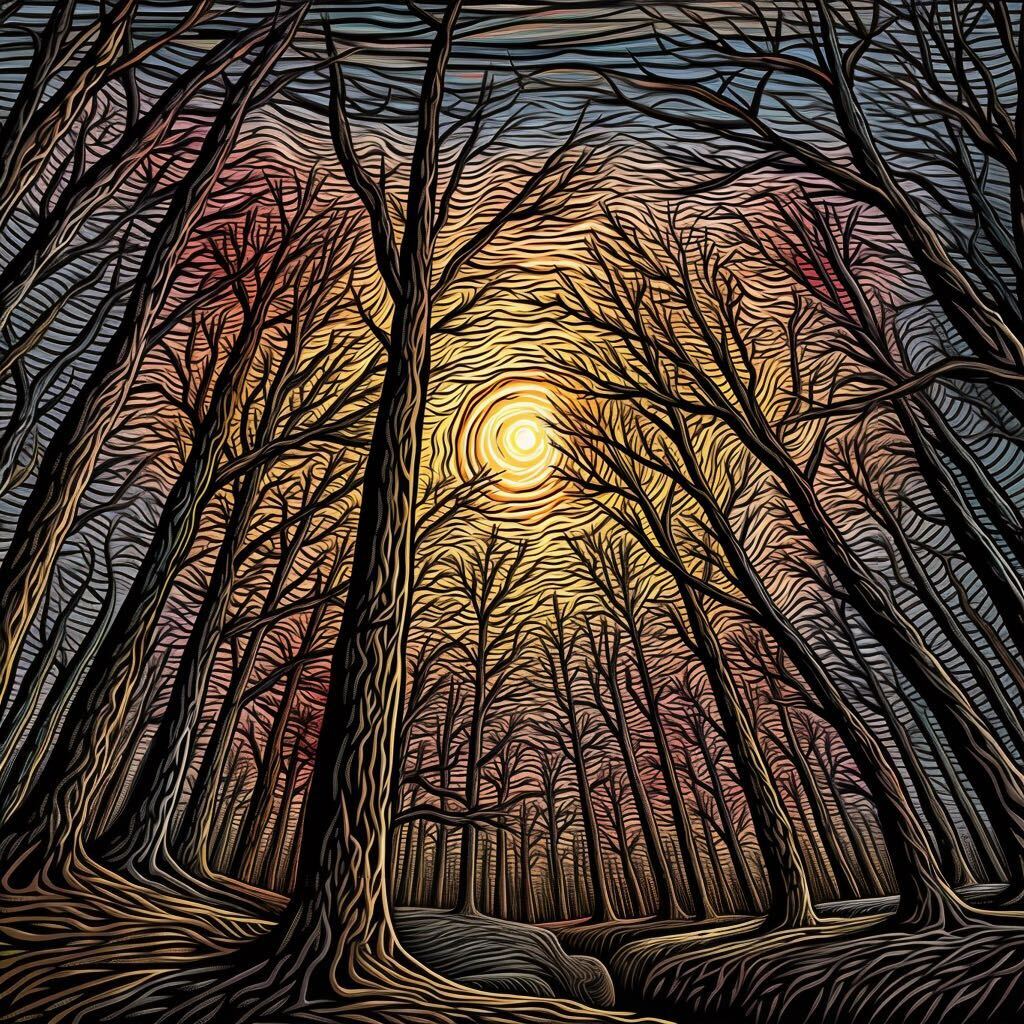
Bare branches hold the early light
the way open hands hold water.
Briefly.
Without trying to keep it.
3
A sparrow lands on the feeder, then another.
No hesitation. No plan.
They arrive.
Eat.
Lave.
Nothing reaches forward.
Nothing looks back.
4
Something releases.
The boundary softens.
A thought: This life I have called mine—what is it?
Not the name.
not the history.
Not the body that no longer obeys.
These are clothes, left draped over a chair in another room.
5
Breath.
Light.
Water moving over stone.
Nothing stands apart.
6
A breeze passes through the trees.
For a moment, the hillside shimmers. One movement:
branch and leaf, air and light and shadow.
You try, gently, to divide it:
wind,
tree,
the one who sees.
The effort feels learned. Not true.
7
A memory: striving, building, holding by force.
Believing there was a center to carry forward.
Not wrong.
Incomplete.
Like mistaking the surface of a stream for its depth.
8
A crow calls from beyond the ridge.
The sound cuts cleanly through the morning. Then dissolves.
No trace. No echo.
9
The mind does not usually move like this.
In darkness, it gathers, arranges,
projects a quiet ground of certainty.
But it flickers.
10
A thought: I am this.
Another: I am that.
Each fades before it can settle into the soil.
What remains has little need for story.
11
The sun lifts higher.
It catches droplets of dew in the grass.
Small splashes of light: yellow, orange, blue, violet.
Appearing,
vanishing,
reappearing.
None held. None lost.
12
What you tried to secure and name, you now feel,
not as idea, but as a snowflake on your palm.
a lattice of starlight, then water.
Never something to hold.
And not a loss.
Only a soft release.
Nothing to solve.
Nothing required.
13
The sparrow returns. Or another. Impossible to tell.
It lands.
Pauses.
Tilts its head.
Gone.
Nothing lingers. Nothing owed.
14
A breath comes.
The body rises,
falls.
Like wind through grass.
In,
out.
15
The ground brightens.
Shadows shorten.
The mist lifts.
What was hidden becomes seen.
Nothing new has been added. Nothing taken away.
It was all there.
Waiting for the light.
16
You see—
with quiet certainty:
This life is not separate.
Not grass,
not trees,
not birds arriving and leaving.
No edge where you end.
No place the world begins.
Only this.
17
And in this,
without effort,
without reaching,
without achieving—
thus.
18
You sit a while longer,
watching the light move.
The mug beside you has gone cold. The faint remains of coffee rings the bottom of the cup.
Nothing to hold.
Nothing to improve.
Nothing missing.
Just this;
always fresh,
always becoming,
complete.
One Response
Having read your jisei… followed by Ahtu, read for the very first time… aloud to myself. I feel at peace. So thank you Bill, for your real help with that. And wherever you are… on the River of Endless Becoming… I wish you pure peace as well.